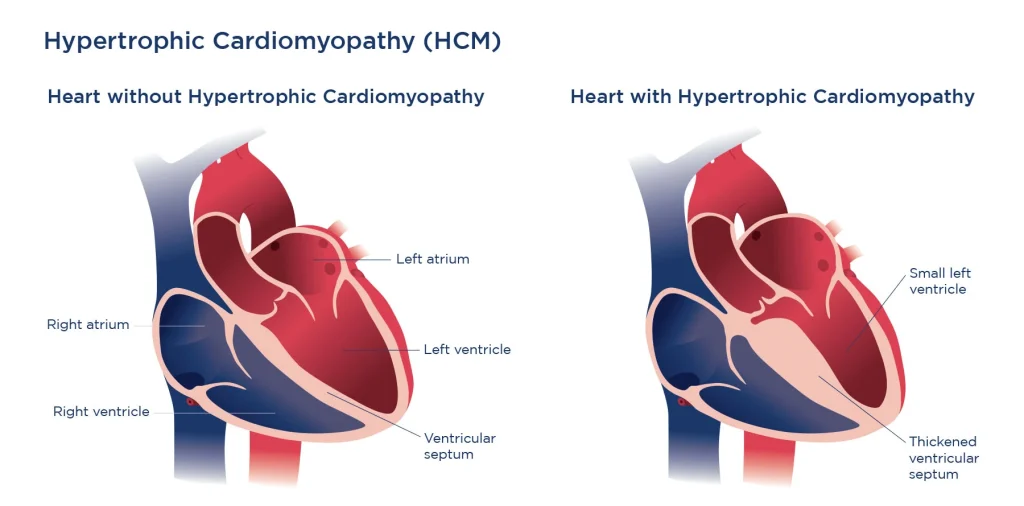
Hypertrophic Cardiomyopathy (HCM)
Hypertrophic cardiomyopathy (HCM)
A guide for people with hypertrophic cardiomyopathy, families, and carers in Australia and New Zealand
Introduction
Hypertrophic cardiomyopathy (HCM) is a condition where the heart muscle becomes abnormally thick. The thickening can make it harder for the heart to pump blood around the body and can also disturb the heart’s electrical system, leading to irregular heart rhythms (arrhythmias).
This information is for people living in Australia and New Zealand who are affected by HCM. It provides general information and should not replace the advice of your doctor or healthcare team.

What is hypertrophic cardiomyopathy?
HCM involves thickening (hypertrophy) of the heart muscle. This thickening affects the lower chambers of the heart (ventricles) and the wall that separates the two ventricles (interventricular septum). It is most commonly found in the left ventricle, which is responsible for pumping blood to your body, but it is sometimes found in the right ventricle.
In HCM the heart muscle is often ‘hypercontractile’, meaning it squeezes harder than normal. This can make it difficult for the heart to fill with blood and pump blood around the body. It can also increase the risk of developing an abnormal heart rhythm.
How common is HCM?
HCM is one of the most common inherited heart conditions. As HCM can be difficult to diagnose, the exact number of cases isn’t known, but it is estimated that between 1 in 250 and 1 in 500 people may be affected, with recent studies suggesting it may be as many as 1 in 200. HCM occurs in both sexes and can present at any age.
Types of HCM
There are two main types of HCM:
- Obstructive HCM (oHCM or historically HOCM)– when
the thickened heart muscle partly blocks blood flow as it leaves the heart. This can make it harder for the heart to pump blood out to the body. - Non-obstructive HCM (nHCM) – when
blood flow is not blocked by the thickening of the heart muscle. In nHCM the thickening may occur in different parts of the heart including in the middle part of the left ventricle (mid-cavity HCM) or at the bottom tip (apex) of the heart (apical HCM).
In a small number of people (less than 5%), the heart muscle can become weaker and stretched over time. This is dilated phase HCM (sometimes called “burnt out” or “end-stage” HCM). This also makes it harder for the heart to pump blood properly.
What causes HCM?
HCM is most often caused by a genetic change (variant) that affects proteins in the heart muscle. These proteins are responsible for helping the heart muscle contract. Changes in these genes affect the heart muscle cells, causing them to become disorganised (known as ‘myocyte disarray’). Over time, this can contribute to thickening of the heart muscle and the development of scar tissue (fibrosis).
The gene changes linked to HCM are autosomal dominant, which means that if one parent has HCM, each child has a 50% chance of inheriting the variant. It isn’t sex-dependent – a parent can pass it down to a child of either sex. Not everyone who inherits a variant will develop symptoms. The same variant can cause different symptoms and severity within a family.
Not all of the genes which cause HCM have been found; a genetic cause is identified in 30-60% of people with HCM. This means that if previous genetic testing did not identify a variant, especially if performed many years ago, repeat genetic testing may be considered to test for newly identified genes. Speak with your cardiologist about whether repeat testing is recommended for you.
What are the symptoms of HCM?
People with HCM may notice a range of symptoms. They can vary widely in severity between people. Symptoms can worsen with physical activity (for example walking up stairs) and some people find that eating a large meal can make them feel unwell.
It is also quite common for people to be asymptomatic, which means they are not experiencing any symptoms of the condition.
Common symptoms include:
- Shortness of breath, especially with physical activity such as exercise, or walking up stairs or a hill.
- Chest discomfort, including pain and/or a feeling of squeezing or pressure. This can be more noticeable during exercise or physical activity, and sometimes when lying down.
- Irregular heartbeat or flutters (palpitations) or feeling a ‘pounding’ heartbeat, sometimes more noticeable when lying down.
- Feeling dizzy or lightheaded, or fainting.
- Feeling unusually tired or having low energy
- Difficulty exercising or performing usual activities
How is HCM diagnosed?
To find out if someone has HCM doctors use a range of tests. Each test helps build a clearer picture. Some of the tests used are:
- Electrocardiogram (ECG): measures heart rhythm and can show if the electrical signals controlling the rhythm are normal. An ECG can be measured in a doctor’s office, or in some cases a portable ECG will be worn for 24–48 hours (sometimes called a Holter monitor).
- Echocardiogram (an ultrasound of the heart): shows if the heart is an unusual shape or size, particularly if the walls of the left ventricle are thickened, and if it is filling up and emptying blood normally.
- Cardiac magnetic resonance imaging (MRI): provides detailed images of the heart muscle that can show changes in shape and size, as well as how well the heart is pumping blood. Some types of MRI which use contrast agents can also highlight areas where scarring has occurred.
- Exercise stress testing: monitors how well your heart is working and its rhythm while you are doing physical activity.
- Genetic testing: looks for the changes in genes known to be linked to HCM, and supports family screening.
- Family screening: close relatives of people diagnosed with genetic changes (variants) that cause HCM are encouraged to receive genetic counselling and testing.
How is HCM treated or managed?
There is currently no cure for HCM, but many people with HCM live long, healthy lives when the condition is well managed. Management is designed to treat symptoms and reduce the risk of complications. This can involve changing your lifestyle, taking medicines, or sometimes having an operation. Treatment can depend on the type of HCM a person has (obstructive or non-obstructive), and the symptoms being experienced.
Treatments that aim to ease symptoms and reduce the risk of complications include:
- Beta-blockers and anti-arrhythmic medicine: used to correct abnormal heart rhythms, reduce blood pressure and heart rate, and reduce how hard the heart contracts.
- Calcium channel blockers: help the heart muscle to relax which can improve blood flow.
- Anticoagulants (blood thinners): lower the risk of blood clots and stroke.
- Myosin inhibitors: reduce excessive contraction of the heart and how hard the heart has to work, and helps to improve blood flow. They are mainly used to treat obstructive HCM (oHCM). They are currently available and PBS-listed in Australia, but are not currently publicly funded or available in New Zealand.
- Catheter ablation:uses a small tube (catheter) to destroy the abnormal tissue in the heart that is causing irregular heartbeats. It is done by a specialist cardiologist in hospital.
- Implantable cardioverter-defibrillators (ICD):are small devices that are implanted under your skin to monitor your heartbeat. If it changes (going too fast, slow or becoming irregular) these devices send an electrical signal that helps the heart to keep a normal heart rhythm. They are generally only recommended for people with HCM at high risk of dangerous arrhythmias.
- Septal reduction therapy:can be done by surgical myectomy (removing a small part of the thickened muscle through open-heart surgery) or alcohol septal ablation (injecting alcohol through a catheter to shrink part of the muscle). This is used for people with severely obstructed blood flow and aims to relieve obstruction and improve symptoms when medicines alone are not enough.
- Heart transplant:in people where symptoms are severe and do not respond to other treatments, a heart transplant may be considered. A heart transplant for HCM is quite rare and only considered in people who meet strict eligibility criteria.
Lifestyle changes that can help maintain general health and manage symptoms include:
- Limit alcohol and avoid recreational drugs: alcohol and recreational drugs can raise your heart rate and increase blood pressure. Limiting alcohol intake is good for your heart.
- Quit smoking: stopping smoking is important for overall health as well as heart and lung health.
- Staying active: physical activity is good for your heart and general health. The amount of exercise that is appropriate will be different for every person and this is particularly important in people with HCM, so it is important to discuss this with your doctor.
- Eating a heart-healthy diet and maintaining a healthy weight: a balanced diet can help to keep a healthy weight, which will reduce the impact on the heart as well as helping with general health. For people who find that large meals trigger their HCM symptoms, smaller, more regular meals may help.
- Staying hydrated: drinking enough water to stay well-hydrated helps to maintain your blood volume. This is essential for people with HCM, but in rare cases of serious HCM your doctor may advise that you reduce the amount of fluid you consume.
- Managing stress and sleep: learning techniques to relax such as breathing exercises and mindfulness and having adequate sleep can help you manage your condition.
- Staying up-to-date with vaccinations: – Vaccinations are recommended by clinicians as they can protect against infections like the flu and COVID-19, which can cause strain on the heart and worsen HCM symptoms. Talk to your doctor about which vaccinations are right for you.
- Keeping a diary: monitoring your weight, fluid intake, ability to exercise, and any other symptoms can help to highlight any changes in your heart health early. Keeping a diary that records this is very helpful for your doctor. Keep up with regular check-ups and let your doctor know if symptoms change.
What are the complications of HCM?
HCM can lead to other serious health problems, including:
- Atrial fibrillation: an irregular rhythm in the upper chambers of the heart. Between 20–30% of people with HCM will develop atrial fibrillation. This may be treated with medicines or an ablation procedure.
- Left ventricular outflow tract obstruction (LVOTO): when the thickened heart muscle partly blocks blood from leaving the heart through the aortic valve. The obstruction is often caused by thickening of the wall between the ventricles. Abnormal movement of the mitral valve during contraction can contribute, known as Systolic Anterior Motion (SAM) of the mitral valve. About 70% of people with HCM have obstruction either at rest or during exercise. Treatment may include medicines (such as beta-blockers or myosin inhibitors), surgical myectomy, or alcohol septal ablation.
- Sudden cardiac arrest: when the heart stops beating properly and a person loses consciousness. This is a serious complication of HCM, but the overall annual risk is low (less than 1% per year in most people with HCM). If someone is at higher risk of having a cardiac arrest, an ICD may be recommended.
- End-stage HCM: involves the heart becoming weakened and less able to contract effectively over time. This happens in less than 5% of people with HCM, 1–2% of which may eventually need a heart transplant.
Where to get support
Support is available for people affected by HCM in both Australia and New Zealand. Your GP and cardiologist are the main contacts for discussing symptoms, treatment options, and ongoing care.
You can also get information and connect with others by joining our private Facebook group, and following our social media channels.
Additional supports:
Australia:
- Heart Foundation Australia: Heartfoundation.org.au
- Cardiac rehabilitation services at your local hospital
- Lifeline (13 11 14) or Beyond Blue (1300 22 4636) for emotional support
New Zealand:
Ask your cardiologist about a heart failure nurse specialist in your area.
Heart Foundation New Zealand:
Mental Health Foundation of New Zealand
The information on this page was developed with the Australian Heart Foundation and members of the CMANZ Medical Advisory Committee.